
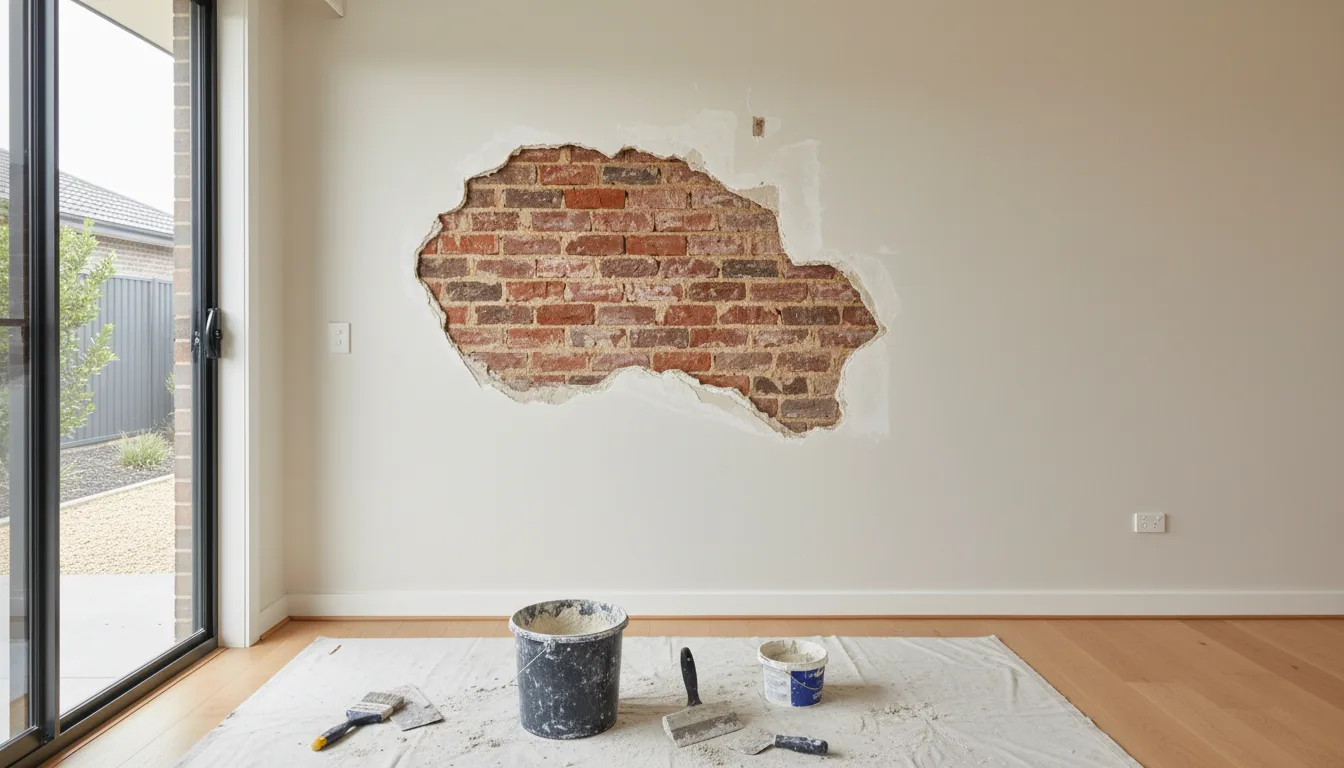
You have found defects in your home. You have told your builder. They may have ignored you, blamed someone else, delayed the repair, or attempted defect rectification works that did not fix the problem.
If your builder is not fixing defects, you need to move from informal conversations to a clear written process. This helps protect your position if the dispute later goes to a regulator, insurer, NCAT, VCAT, or another dispute body.
In NSW and Victoria, homeowners have formal pathways for defective building work. NSW homeowners can use the Building Commission NSW complaint process, and NCAT can hear residential building work disputes after the required pre-application steps.
In Victoria, homeowners should first try to resolve the issue directly, then put the issue in writing, and then apply for domestic building dispute resolution through the Building and Plumbing Commission if the dispute remains unresolved.
This guide explains what to do when your builder won’t fix defects, how long a builder may have to fix defects in NSW and Victoria, and when to get a defect investigation report.
Builder Not Fixing Defects? Start Here
A defect is not just something you dislike. In Victoria, Consumer Affairs Victoria describes defects as work that breaches the contract by failing to meet a required standard or quality, or work that breaches an implied warranty.
In NSW, the Home Building Act 1989 gives homeowners statutory warranty rights for residential building work. The Act sets a 6-year warranty period for major defects and a 2-year period for other defects.
If you have a problem with a builder, treat the issue as an evidence process. Your goal is to show what the defect is, where it is located, when you raised it, what the builder said, and whether the builder had a fair chance to inspect and fix it.
Common signs that you may need to escalate include:
| Situation | What It May Mean | Next Step |
|---|---|---|
| Builder ignores emails or calls | Poor response record | Send a formal written notice |
| Builder says the defect is “normal” | Dispute over workmanship | Get an independent defect inspection |
| Builder attempts a repair but the issue returns | Incomplete or poor rectification | Document the failed repair |
| Builder refuses access or delays repeatedly | Escalation may be needed | Prepare complaint documents |
| Builder has disappeared, died or become insolvent | Insurance may become relevant | Check NSW HBC or VIC DBI cover |
Builder Refusing to Fix Defects: What to Do First
If your builder is refusing to fix defects, do not rely on verbal promises. Put the issue in writing and keep records.
Consumer Affairs Victoria advises homeowners to try resolving the dispute directly first, keep copies of relevant documents, record conversations, and take photographs of the disputed work.
A clear written record helps if you later need to report a builder, lodge a building defect complaint, apply to NCAT, apply to VCAT, or make an insurance claim.
Before escalating, prepare:
- The building contract
- Approved plans and specifications
- Occupancy permit, occupation certificate, or certificate of final inspection
- Photos and videos of the defects
- Emails, text messages, and call notes
- Any previous defect list or handover report
- Invoices, receipts, and payment records
- Independent defect investigation report, if available
Need Evidence for a Building Defect Claim?
Owner Inspections can inspect the issue, document the defect, and prepare a clear report to support your next step.
Investigation
Step 1: Send a Written Notice of Defect
Start with a written notice of defect. This gives the builder a clear chance to respond and creates a paper trail.
In Victoria, Consumer Affairs Victoria advises homeowners to send a letter or email formally outlining the issue and requesting a response if they cannot resolve the problem by speaking with the builder directly.
Your notice should include:
| What to Include | Why It Matters |
|---|---|
| Property address | Confirms the work in dispute |
| Contract details | Connects the defects to the agreed scope |
| Defect list | Shows each issue clearly |
| Photos | Gives visual evidence |
| Location of each defect | Helps the builder inspect and respond |
| Date first noticed | Supports your timeline |
| Requested repair | Shows the outcome you want |
| Response deadline | Creates a clear next step |
| Warning of escalation | Shows that you may lodge a complaint if ignored |
Use simple wording. For example:
I am writing to notify you of defective building work at [property address]. Please see the attached defect list and photographs. Please confirm within 14 days when you will inspect and rectify the defects. If I do not receive a response, I may lodge a formal complaint with the relevant authority.
Send the notice by email and keep a copy. If you send it by post, Consumer Affairs Victoria recommends using registered mail.
Tip
Even if you have already raised the defects verbally or through informal messages, a formal written notice resets the clock and creates a clear paper trail. Tribunals take formal notices seriously because they demonstrate that the builder was given fair warning.
What Happens After You Send the Notice
There are three typical outcomes.
- The builder may respond and arrange to inspect and rectify the defects.
- The builder may respond and dispute the defects.
- The builder may not respond at all.
If the builder responds and arranges rectification, supervise the work carefully and document the results. If the repairs are inadequate, you will need to go through the process again. If the builder disputes the defects or fails to respond, proceed to the next step.
Step 2: Get an Independent Defect Investigation Report
If the builder disagrees, delays, or refuses to fix the work, get independent evidence.
A defect investigation report can identify the defective building work, record its location, explain likely causes, and give repair recommendations. It can also help separate genuine building defects from cosmetic issues, maintenance issues, design disputes, or contract disagreements.
This matters because regulators and tribunals usually need evidence, not just frustration. NCAT tells applicants to provide relevant documents such as the contract, repair quotes, and photos when applying in home building matters under $30,000.
A good defect report may include:
| Report Item | Why It Helps |
|---|---|
| Defect description | Clearly explains the issue |
| Location | Shows exactly where the defect appears |
| Photos | Supports the written finding |
| Likely cause | Helps identify faulty workmanship or material issues |
| Relevant standard or requirement | Supports the technical basis |
| Severity | Helps separate minor defects from major defects |
| Recommended rectification | Gives the builder or tribunal a practical repair pathway |
Choose a building consultant who is independent of the builder and has experience with defect investigations. If there is any chance the matter will reach a tribunal, check that the consultant has experience providing expert evidence and is willing to attend a hearing if required.
Step 3: Lodge a Complaint with the Regulator
If the builder does not respond or refuses reasonable rectification, the next step depends on your state.
| State | First Main Pathway | Tribunal Pathway |
|---|---|---|
| NSW | Building Commission NSW / NSW Fair Trading complaint process | NCAT |
| Victoria | Building and Plumbing Commission dispute resolution service, previously known as DBDRV | VCAT |
Building Commission NSW provides a free complaint handling service for complaints about home building work, including houses, multi-unit dwellings, and specialist trade work.
The Building and Plumbing Commission provides a free domestic building dispute resolution service for consumers and practitioners in Victoria, and this service was previously known as Domestic Building Dispute Resolution Victoria.
NSW: NSW Fair Trading
In New South Wales, building complaints are handled by NSW Fair Trading under the Home Building Act 1989. You can lodge a complaint online, by phone, or by visiting a Fair Trading centre.
When you lodge a complaint, Fair Trading may:
- Contact the builder and request that they respond to your complaint
- Arrange a mediation or conciliation session between you and the builder
- Issue a rectification order requiring the builder to fix the defects
- Take disciplinary action against the builder's licence if the matter involves serious non-compliance
Fair Trading can be an effective first step, particularly for straightforward defect claims. However, their power to enforce rectification is limited. If the builder still refuses to act after Fair Trading's intervention, you may need to apply to the tribunal.
Victoria: Victorian Building Authority (VBA)
In Victoria, the Victorian Building Authority (VBA) handles building complaints under the Building Act 1993 and the Domestic Building Contracts Act 1995.
The VBA can:
- Investigate the complaint and inspect the property
- Issue building notices and building orders requiring the builder to rectify defective work
- Take disciplinary action against the builder's registration
- Refer the matter for dispute resolution through Domestic Building Dispute Resolution Victoria (DBDRV)
Important
In Victoria, before you can apply to VCAT for a domestic building dispute, you must first apply to DBDRV for dispute resolution. This is a mandatory step introduced by the Domestic Building Contracts Act 1995 (as amended). DBDRV offers assessment and conciliation services at no cost to the homeowner.
Step 4: Mediation
Mediation is a structured negotiation process where an independent mediator helps you and the builder reach an agreement. It is less formal and less expensive than a tribunal hearing, and many building disputes are resolved at this stage.
How Mediation Works
The mediator does not make a decision or issue orders. Their role is to facilitate a discussion, help both parties understand each other's position, and work towards a mutually acceptable outcome. If you reach an agreement, it is put in writing and signed by both parties. The agreement can then be enforceable.
Mediation in NSW
In NSW, Fair Trading offers a free mediation service for building disputes. You can also engage a private mediator if you prefer. Having your defect investigation report available during mediation strengthens your position because it provides independent evidence of the defects and their estimated repair cost.
Mediation in Victoria
In Victoria, DBDRV provides assessment and conciliation for domestic building disputes. This is a mandatory step before applying to VCAT. If DBDRV cannot resolve the dispute, they will issue a certificate that allows you to proceed to the tribunal.
Mediation only works if both parties are willing to negotiate in good faith. If the builder refuses to engage with the process or will not agree to a reasonable outcome, you will need to escalate to the tribunal.
Step 5: Apply to the Tribunal
If mediation and regulatory complaints have not resolved the dispute, the next step is to apply to the relevant tribunal for a formal hearing and binding orders.
NSW: NCAT (NSW Civil and Administrative Tribunal)
NCAT can hear and decide disputes about residential building work in NSW. NCAT can make orders about payment for home building work, incomplete or defective home building work, specialist work, damage caused by home building work, and insurance claim appeals.
Before NCAT can accept most home building applications, the dispute must first be referred to NSW Fair Trading, unless an exemption applies.
NCAT can:
- Order the builder to carry out specific rectification work
- Order the builder to pay compensation for the cost of having the defects fixed by another contractor
- Order the builder to pay damages for consequential losses, such as temporary accommodation costs during repairs
- Make findings on the quality of work and compliance with the Home Building Act 1989
For claims under $30,000, NCAT says homeowners must first take part in the NSW Fair Trading dispute resolution process, which may involve a building inspector or direct referral to NCAT.
Victoria: VCAT (Victorian Civil and Administrative Tribunal)
VCAT hears domestic and commercial building disputes between owners, builders, subcontractors, architects, engineers, and other building practitioners.
VCAT says it generally cannot help with domestic building work disputes involving a homeowner if the matter has not first been to DBDRV, now part of the Building and Plumbing Commission, unless the applicant seeks an injunction.
VCAT can:
- Order the builder to rectify defects or pay the cost of rectification
- Award compensation for losses caused by the defective work
- Make orders regarding incomplete or abandoned building work
- Determine whether work complies with the Domestic Building Contracts Act 1995 and the Building Act 1993
If your matter may go to VCAT, organise your evidence early. VCAT’s building and construction resources include preparation topics such as evidence, witnesses, and expert reports.
Tip
At both NCAT and VCAT, your defect investigation report is critical evidence. If the builder disputes the defects, the tribunal will rely heavily on independent professional evidence to make its decision. Without a report from a qualified building consultant, your claim is significantly weaker.
Preparing for NCAT, VCAT or a Building Dispute?
If your matter needs formal expert evidence, our team can prepare an expert witness report for building defect disputes.
Reports
Documents to Prepare Before Escalating
Strong documentation can make a major difference when dealing with defective building work.
| Document | Why You Need It |
|---|---|
| Building contract | Shows the agreed scope, price, stages, and terms |
| Approved plans and specifications | Helps confirm whether work matches the agreed documents |
| Defect list | Gives a clear issue-by-issue record |
| Photos and videos | Shows the condition of the work |
| Emails and text messages | Proves when you notified the builder |
| Written notice of defect | Shows that you made a reasonable attempt to resolve the issue |
| Defect investigation report | Provides independent technical evidence |
| Repair quotes | Helps quantify the cost of rectification |
| Occupation certificate, occupancy permit, or final inspection certificate | Helps confirm completion dates |
| Insurance certificate | Helps identify whether HBC or DBI may apply |
Builder Not Fixing Defects in NSW
If your builder is not fixing defects in NSW, start by trying to resolve the issue with the builder. If that fails, lodge a complaint through the NSW building dispute process. Building Commission NSW says homeowners should try to resolve the matter with the contractor or builder before making a complaint.
For home building complaints after completion, Building Commission NSW provides a free complaint handling service and can help with complaints under the Home Building Act 1989. A Building Commission NSW inspector may inspect the disputed items and either issue a rectification order or conclude that the builder is not responsible for the alleged defects.
A rectification order can list the work to be rectified or completed, set conditions for the parties, and set a completion date for the work. If the builder does not comply with a rectification order, or if you disagree with the decision, you may lodge a claim with NCAT.
QHow Long Does a Builder Have to Fix Defects in NSW?
There is no single repair timeframe that applies to every defect in every NSW building dispute. The timeframe can depend on the contract, the type of defect, access, urgency, the complaint process, and any rectification order.
NSW statutory warranty periods are strict. For contracts signed on or after 1 February 2012, NSW gives 6 years for major defects and 2 years for all other defects. If the loss becomes apparent in the last 6 months of the warranty period, the homeowner has a further 6 months to enforce the statutory warranty.
This means you should not wait too long. If your warranty period is close to ending, get advice and act quickly.
Builder Not Fixing Defects in Victoria
If your builder is not fixing defects in Victoria, first try to resolve the issue directly with the builder. Keep written communications, photographs, contract documents, invoices, and any other relevant evidence.
If direct contact does not resolve the dispute, send a formal letter or email that outlines the issue and requests a response.
If the builder still does not respond, you can apply for domestic building dispute resolution through the Building and Plumbing Commission. The BPC service was previously known as Domestic Building Dispute Resolution Victoria, or DBDRV.
The BPC offers a free and impartial service to help resolve domestic building disputes without the cost or delay of going to court.
If conciliation does not resolve the dispute, the BPC can issue binding dispute resolution orders or certificates that allow the dispute to progress to VCAT.
QHow Long Does a Builder Have to Fix Defects in Victoria?
There is no single repair deadline for every Victorian building defect. The timeframe can depend on the contract, the defect type, the dispute resolution process, and any order made by the BPC or VCAT.
Victoria’s implied warranties apply to domestic building work, and builders must carry out work in a proper and workmanlike manner, use suitable materials, comply with laws and legal requirements, complete work with reasonable care and skill, and ensure completed homes are suitable for occupation.
Consumer Affairs Victoria states that the Building Act 1993 allows action against a builder for up to 10 years from the date the work was completed, and that this right transfers to a new owner if the property is sold within that time.
How Long Does a Builder Have to Fix Defects?
Many homeowners search for how long does a builder have to fix defects because they want a clear deadline. The practical answer is this: give the builder a reasonable written deadline, but also watch the legal warranty periods.
| State | Main Time Limit / Warranty Period | Important Note |
|---|---|---|
| NSW | 6 years for major defects and 2 years for other defects | NSW may allow a further 6 months if the loss becomes apparent in the last 6 months of the warranty period. |
| Victoria | Action may be brought for up to 10 years from completion | Domestic building insurance has separate cover limits: 6 years for structural defects and 2 years for non-structural defects. |
Do not confuse a builder’s repair deadline with a statutory warranty period. A repair deadline is the timeframe you give the builder to respond or rectify. A statutory warranty period is the legal timeframe that may affect your right to bring a claim.
Understanding Warranty Periods
Every step in this process is governed by statutory warranty periods. If you miss the deadline, you may lose the right to pursue the builder entirely.
| Warranty Type | NSW (Home Building Act 1989) | Victoria (Domestic Building Contracts Act 1995) |
|---|---|---|
| Minor defects (non-structural) | 2 years from completion | 2 years from completion (domestic building insurance) |
| Major defects (structural) | 6 years from completion | 10 years from completion |
| Starting point | Date of practical completion or occupation certificate | Date of practical completion or occupancy permit |
Warranty periods run from practical completion, not from when you moved in or noticed the defect. If your home was completed two years ago but you only discovered the defect recently, you may still be within time for major defects but out of time for minor ones. Check your dates carefully and act promptly.
QWhat Counts as a Major Defect?
In NSW, a major defect is defined in the Home Building Act 1989 as a defect in a major element of a building that is attributable to defective design, defective or faulty workmanship, defective materials, or failure to comply with the structural performance requirements of the NCC. A major element includes the internal or external load-bearing parts of a building, fire safety systems, and waterproofing.
In Victoria, the Domestic Building Contracts Act 1995 covers structural defects for ten years. These include defects affecting the structural soundness of the building, waterproofing failures, and issues that make the building unfit for habitation.
Practical Steps to Protect Yourself
Regardless of which stage of the dispute you are at, these practical steps will help protect your position:
- Document everything from the moment you first notice a problem, including photographs, written notes, and dates
- Always communicate with the builder in writing and keep copies of all correspondence
- Do not attempt permanent repairs before the builder has inspected the defects and you have independent documentation of the original condition
- Obtain an independent defect investigation report as early as possible
- Keep receipts for any temporary repairs you carry out to prevent further damage
- Do not accept verbal promises from the builder without written confirmation of what will be done and by when
- Be aware of your warranty period deadlines and act well before they expire
- If the amount at stake is significant, consider getting legal advice from a solicitor who specialises in building disputes
What If the Builder Has Gone Out of Business?
If the builder has died, disappeared, become insolvent, or can no longer complete or fix the work, insurance may become relevant.
NSW Home Building Compensation Cover
In NSW, home building compensation insurance is required for residential building work over $20,000, including GST, unless an exemption applies.
SIRA states that this cover protects homeowners and future homeowners when a building business cannot complete the work or rectify defects because of insolvency, death, disappearance, or certain licence suspension situations.
Victoria Domestic Building Insurance
In Victoria, builders or tradespeople must take out domestic building insurance for clients when the cost of works exceeds $16,000.
Domestic building insurance gives limited cover if the builder or tradesperson dies, becomes insolvent, or disappears. If the policy was issued on or after 1 July 2015, it can also provide cover if the builder fails to comply with a final VCAT or court order.
Consumer Affairs Victoria states that domestic building insurance covers costs up to $300,000 to fix structural defects for 6 years and non-structural defects for 2 years.
Important
Home warranty insurance and domestic building insurance only apply when the builder is unable to fulfil their obligations (for example, due to insolvency or death). They do not apply when the builder is simply refusing to carry out repairs. In that situation, you need to pursue the builder directly through the regulator or tribunal.
Unsure What Evidence You Need?
Speak with Owner Inspections about your defect concern and the right inspection report for your situation.
Inspections
Key Takeaways
- Always start with a formal written notice to the builder, listing every defect with photographs and a deadline for rectification.
- Obtain an independent defect investigation report to provide professional evidence of the defects, their cause, and the estimated repair cost.
- In NSW, lodge a complaint with NSW Fair Trading. In Victoria, lodge a complaint with the VBA and apply to DBDRV before going to the tribunal.
- Mediation is often effective and less costly than a tribunal hearing. Many disputes are resolved at this stage.
- If mediation fails, apply to NCAT (NSW) or VCAT (Victoria) for binding orders requiring the builder to rectify or compensate.
- Warranty periods are strict. Minor defects must be claimed within two years and major defects within six years (NSW) or ten years (Victoria) of completion.
- If the builder has gone out of business, home warranty insurance or domestic building insurance may cover the cost of rectification.
- Document everything from day one. Strong evidence is the foundation of every successful defect claim.
Concerned About Building Defects?
Our licensed inspectors cover Sydney, Melbourne, and all major Australian cities.
Frequently Asked Questions
What should I do if my builder is not fixing defects?
Start by writing to the builder with a clear defect list, photographs, and a reasonable response deadline. If the builder does not respond or refuses to fix the issue, get independent evidence and use the complaint pathway in your state.
What happens if a builder refuses to fix defects?
If a builder refuses to fix defects, you may need to lodge a complaint with the relevant state process. In NSW, Building Commission NSW can provide complaint handling assistance and may involve a building inspector. In Victoria, you can apply for domestic building dispute resolution through the Building and Plumbing Commission if you have tried to resolve the issue directly first.
How long does a builder have to fix defects in NSW?
NSW does not give one universal repair timeframe for every defect. However, NSW statutory warranty periods are 6 years for major defects and 2 years for other defects, with a possible further 6 months if the loss becomes apparent in the last 6 months of the warranty period.
How long does a builder have to fix defects in Victoria?
Victoria does not give one universal repair timeframe for every defect. However, Consumer Affairs Victoria states that action can be brought against a builder for up to 10 years from completion, while domestic building insurance has separate cover periods of 6 years for structural defects and 2 years for non-structural defects.
Can I report a builder for defective building work?
Yes. In NSW, homeowners can make complaints about home building work through the Building Commission NSW complaint process. In Victoria, homeowners can use the Building and Plumbing Commission’s free domestic building dispute resolution service after first trying to resolve the dispute with the builder.
Do I need a defect investigation report?
You should consider a defect investigation report if the builder disputes the defect, ignores you, says the work is acceptable, or attempts repairs that do not fix the issue. A report can help document the defective building work, its location, likely cause, and repair recommendation.
Can I go straight to NCAT if my builder won’t fix defects?
Usually, no. NCAT says home building disputes must first be referred to NSW Fair Trading unless an exemption applies.
Can I go straight to VCAT if my builder won’t fix defects in Victoria?
Usually, no. VCAT says it generally cannot help with domestic building disputes involving a homeowner if the matter has not first been to DBDRV, now part of the Building and Plumbing Commission, unless the applicant seeks an injunction.
Related Articles
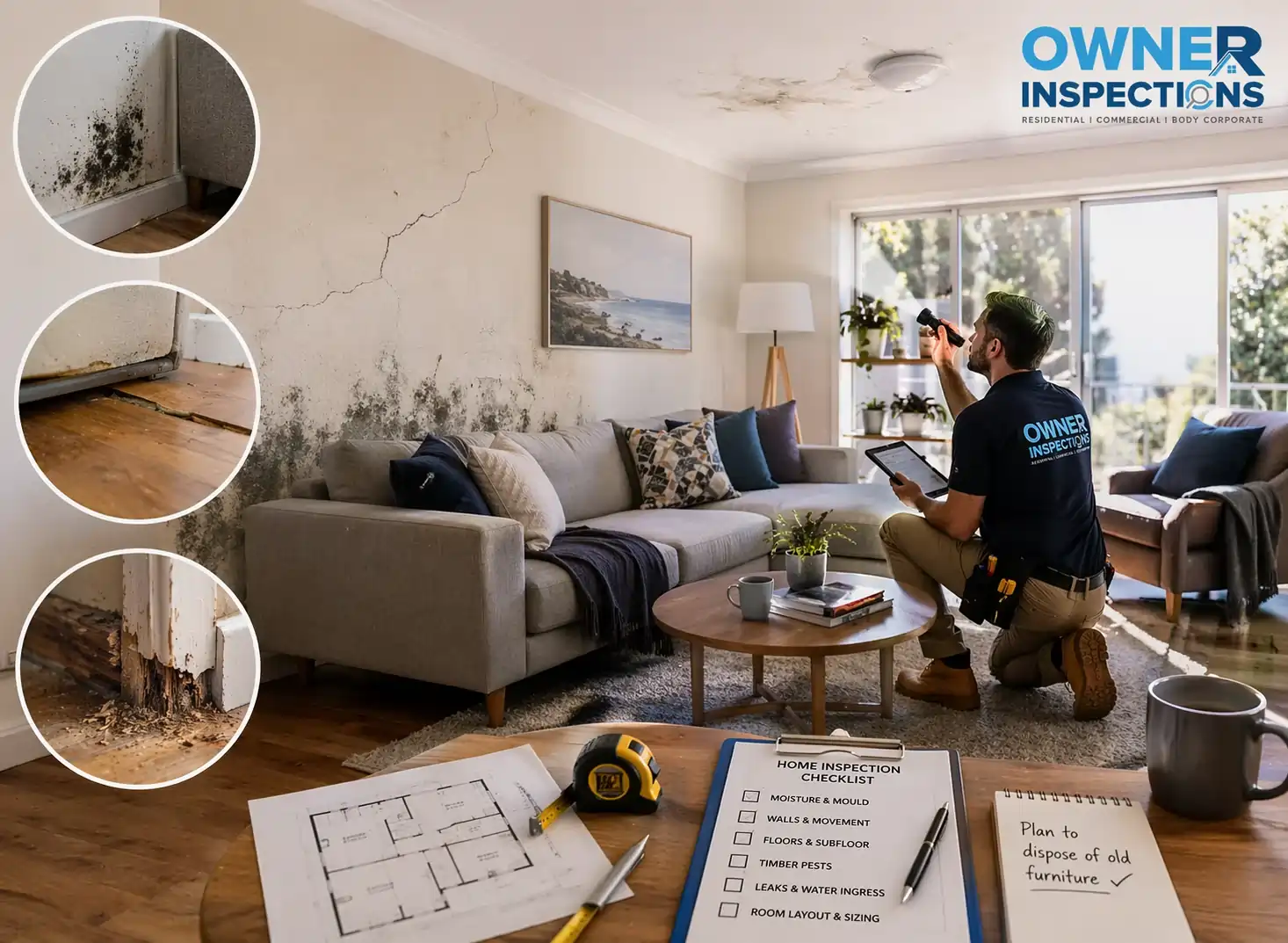
6 Hidden Home Issues to Check Before Replacing Your Living Room Furniture
Before replacing your living room furniture, check whether the real problem is hidden in the room itself. This guide explains how to spot damp, mould, cracks, uneven floors, leaks and termite damage, then decide whether you need an inspection, a repair, or simply a better furniture plan.
Common Frame Defects and How to Address Them
A home's framing system serves as its structural skeleton. This guide covers common frame defects in Australian homes, their causes, and how to identify and address them during construction inspections.

Common Swimming Pool Defects: What You Need to Know
With approximately one in seven Australian households owning a pool or spa, pool defects are a widespread concern. Cracks, leaks, staining, scaling, corrosion, and algae growth can all compromise pool safety and lead to expensive repairs. This guide covers the most common defects, their causes, and how regular inspections help catch problems early.