
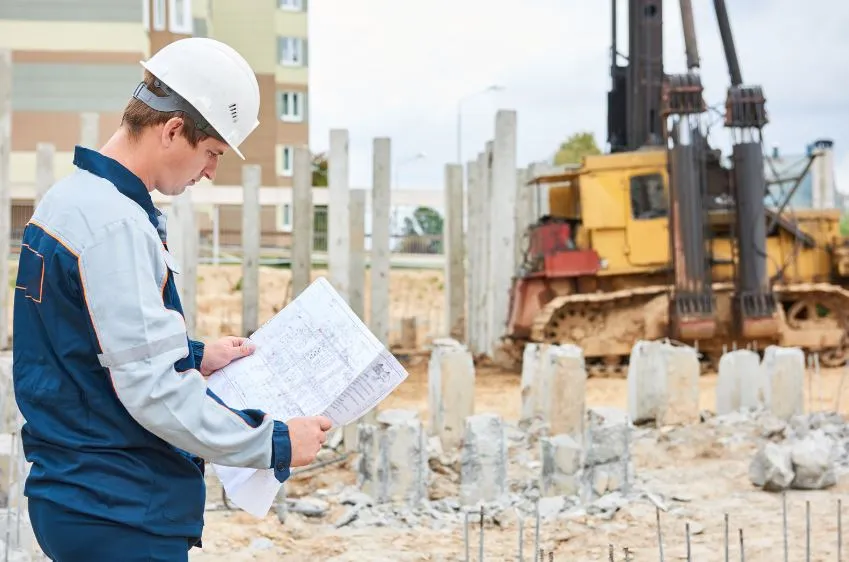
Bored piers and driven piles both support buildings by transferring loads from the structure into stronger ground below. The main difference is how they are installed. Bored piers are drilled, reinforced and filled with concrete in place, while driven piles are pushed, hammered or driven into the ground as prefabricated or partly prefabricated elements.
For Australian homes, townhouses, apartments and commercial buildings, the right foundation type depends on soil conditions, site access, structural loads, vibration limits, engineering design and local building requirements. AS 2870 covers residential slabs and footings, while AS 2159 is referenced for piling design and installation in Australian piling specifications.
For property buyers, the concern is not only whether a home has bored piers or driven piles. The bigger issue is whether the foundation system shows signs of movement, cracking, poor drainage, settlement or hidden construction defects. A pre-purchase inspection can help identify visible defects, structural concerns, moisture damage and safety issues before a buyer commits to the property. Owner Inspections’ pre-purchase service page says the inspection helps identify defects and safety concerns before purchase, including structural issues, moisture damage and pest concerns.
What Are Bored Piers?
Bored piers are deep foundation supports made by drilling cylindrical holes into the ground, placing steel reinforcement inside the holes and pouring concrete into them. In technical documents, this type of work may be described as cast-in-place reinforced concrete piling. Austroads ATS 5240 sets out requirements for piles constructed with cast-in-place reinforced concrete, including unlined piles and piles with steel lining.
A bored pier helps transfer building loads through weaker surface soil and into stronger soil or rock below. This makes bored piers useful on sites with reactive clay, fill, soft ground, sloping land, nearby structures or areas where vibration from driven piles may create risk.
How Bored Piers Are Constructed
| Step | What Happens | Why It Matters |
|---|---|---|
| Site set-out | Pier locations are marked from engineering drawings | Keeps the bored piers aligned with the design |
| Drilling | A rig drills each bore hole to the required depth and diameter | Helps reach the required founding material |
| Bore support | Casing or support methods may be used in unstable ground | Reduces collapse risk before concrete placement |
| Reinforcement | Steel reinforcement cages are placed inside the bore | Helps the pier resist structural forces |
| Concrete pour | Concrete is placed into the drilled hole | Forms the finished concrete bored pier |
| Connection | The pier is connected to a slab, footing beam, pile cap or ground beam | Transfers building loads into the pier |
Site preparation and set-out
The exact positions for each pier are marked on the ground according to the engineering drawings. The drilling rig is positioned at the first location.
Drilling
A rotary drilling rig bores a hole to the required depth and diameter. Depending on soil conditions, temporary casing or drilling fluid may be used to prevent the hole from collapsing during excavation.
Reinforcement placement
A prefabricated steel reinforcement cage is lowered into the drilled hole. The cage provides tensile strength to the finished pier.
Concrete pour
Concrete is poured into the hole, filling it from the bottom up. If casing was used, it is withdrawn as the concrete rises.
Curing and trimming
The concrete cures to form a solid column. The top of the pier is trimmed to the correct level before the ground beam or slab is constructed on top.
Austroads ATS 5240 includes requirements for pile hole inspection, founding level, reinforcement, concrete placement, pile testing, records and certification, which shows why bored piers construction needs proper site control.
Advantages of Bored Piers
- Flexible in size and depth, suitable for a wide range of project requirements
- Effective in complex soil conditions, including reactive clays, rock, and ground with underground obstructions
- Produces significantly less noise and vibration than driven piles, making them suitable for urban and sensitive sites
- Can achieve very high load-bearing capacities by drilling into bedrock or competent strata
- Can be constructed in areas with limited overhead clearance
Limitations of Bored Piers
- Generally more time-consuming to construct than driven piles
- Can be more expensive due to specialised drilling equipment and the need for casing in unstable ground
- Quality depends heavily on the drilling and concreting process, as defects (such as voids or poor concrete coverage) can occur underground and are difficult to detect
- Spoil (excavated soil) must be removed from the site and disposed of
What Are Driven Piles?
Driven piles are foundation elements installed by driving prefabricated or partly prefabricated piles into the ground. Austroads ATS 5230 covers driven piles, including prestressed concrete piles, reinforced concrete piles, steel piles, tubular piles and composite piles.
Driven piles are often used where ground conditions allow efficient driving and where the project needs faster installation. The pile is driven until it reaches the required depth, resistance or founding condition set by the engineering design.
How Driven Piles Are Constructed
| Step | What Happens | Why It Matters |
|---|---|---|
| Pile selection | The engineer selects the pile type, length and size | Matches the foundation to the loads and ground |
| Delivery | Piles are brought to site before installation | Saves time compared with forming each pile in place |
| Positioning | A rig or crane places the pile at the set-out point | Helps keep the pile layout accurate |
| Driving | The pile is driven into the ground using suitable equipment | Transfers loads to stronger ground |
| Monitoring | Driving behaviour and resistance are recorded | Helps confirm installation performance |
| Connection | The pile head is cut and connected to the structure above | Completes the load path |
Pile fabrication
Piles are manufactured off-site in a controlled environment to specified dimensions and strength requirements.
Site delivery and positioning
Prefabricated piles are transported to the site and positioned at the marked locations using a crane.
Pile driving
A pile-driving rig uses a heavy hammer to drive each pile into the ground with repeated blows. The process continues until the pile reaches the target depth or meets the required resistance (refusal).
Head trimming
Once installed, the top of the pile is trimmed to the correct level for connection to the pile cap, ground beam, or slab.
Austroads ATS 5230 includes monitoring of pile driving, acceptance of piles, pile testing, installation records and certification of conformance.
Advantages of Driven Piles
- Faster installation than bored piers in suitable soil conditions
- Prefabrication ensures consistent quality control
- High load-bearing capacity, particularly in granular soils
- No spoil (excavated material) to remove from site
- Can be driven through soft layers to reach firm bearing strata
Limitations of Driven Piles
- Generates significant noise and vibration during installation, which can be disruptive in urban areas and may trigger dilapidation concerns for neighbouring properties
- Difficult or impossible to install in hard rock or ground with large underground obstructions
- Less flexible in terms of depth adjustments once fabricated
- May cause ground heave or displacement in cohesive soils
Bored Piers vs Driven Piles Comparison
The biggest difference between bored and driven piles is the installation method. Bored piles or bored piers are drilled and concreted in place, while driven piles are installed by driving a pile into the ground.
| Factor | Bored Piers | Driven Piles |
|---|---|---|
| Installation method | Drilled, reinforced and concreted in place | Driven, hammered or pushed into the ground |
| Noise | Usually lower than driven piles | Can be noisy during installation |
| Vibration | Usually lower | Can create vibration near nearby buildings |
| Spoil | Produces soil and rock spoil | Usually produces less spoil |
| Best use | Complex ground, tight sites, lower-vibration sites, rock sockets | Suitable soils, larger projects, faster programmes |
| Main risk | Hidden defects inside the bore or concrete | Noise, vibration, pile damage or refusal |
| Inspection need | Bore depth, base cleanliness, cage position and concrete placement | Driving records, pile condition, alignment and acceptance |
Austroads includes noise, vibration and property damage considerations in both cast in place pile and driven pile specifications, which is why nearby buildings and site conditions matter when choosing between bored piers and driven piles.
Piers vs Piles: What Is the Difference?
In simple terms, a pier is a vertical support that carries building loads down into the ground, while a pile is usually a deeper foundation element that transfers loads into stronger soil or rock below the surface.
In residential construction, the term “bored pier” is often used for a drilled concrete foundation support. In engineering documents, the same support may be described as a bored pile, especially where it forms part of a deeper or larger foundation system.
| Term | Plain-English Meaning | Common Use |
|---|---|---|
| Pier | A vertical foundation support | Residential building language |
| Bored pier | A drilled concrete pier formed in the ground | House foundations, slabs, extensions |
| Pile | A deep foundation element | Engineering and commercial construction |
| Driven pile | A pile driven into the ground | Civil, commercial and some residential projects |
| Bored pile | A drilled and concreted pile | Larger deep foundation works |
The key difference between piers and piles is usually depth, design language and project type. For property buyers, the more practical question is whether the foundation shows signs of cracking, movement, settlement or poor drainage.
When to Choose Bored Piers
- The site has complex or variable soil conditions, including reactive clays, fill material, or underground obstructions
- The project is in a noise-sensitive urban area where pile-driving vibration could damage neighbouring structures or breach council noise regulations
- The structure requires very high load-bearing capacity that can only be achieved by drilling into bedrock
- The site has limited access that prevents large pile-driving rigs from operating
Bored Piles Advantages and Disadvantages
| Advantages of Bored Piles and Bored Piers | Disadvantages of Bored Piles and Bored Piers |
|---|---|
| Useful where weak surface soils need to be bypassed | Can be slower than driven piles |
| Lower vibration than many driven pile methods | Produces spoil that must be removed |
| Can be designed for different depths and diameters | Needs careful inspection before concrete placement |
| Useful for rock sockets and complex ground | Defects can be hidden below ground |
| Suitable for many tight urban sites | May need casing, support fluid or water control |
Austroads ATS 5240 covers cast in place reinforced concrete piles, including pile construction, drilling support fluids, steel liners, founding level, reinforcement, concrete placement, pile testing and records.
When to Choose Driven Piles
- The soil is granular (sand, gravel) and suitable for pile driving without risk of refusal from rock
- Speed is a priority and the site allows for the noise and vibration of pile driving
- The project budget favours the lower cost of prefabricated piles in suitable conditions
- Quality control through factory prefabrication is preferred over in-situ concrete work
Driven Piles Advantages and Disadvantages
| Advantages of Driven Piles | Disadvantages of Driven Piles |
|---|---|
| Fast installation in suitable ground | Noise can affect nearby properties |
| Factory-made pile quality can be consistent | Vibration can affect nearby structures |
| Usually produces less spoil than bored piers | Obstructions or rock can cause refusal |
| Driving records provide useful installation data | Pile damage can occur during installation |
| Useful for civil and commercial projects | Access and headroom can limit use |
Austroads ATS 5230 covers driven pile supply and installation, including concrete piles, steel piles, tubular piles, monitoring of pile driving, pile acceptance, pile testing, installation records and certification.
Concrete Bored Piers and Bored Pier Footing
Concrete bored piers are formed by drilling a hole, placing steel reinforcement and filling the shaft with concrete. Once cured, the pier acts as a vertical support below the structure.
A bored pier footing is the part of the foundation system where the bored pier connects to the slab, ground beam, pile cap or footing above. This connection matters because it transfers the building load into the pier and then into stronger ground.
The Victorian Building Authority explains that footings support the building, while the foundation is the soil or rock that supports the footings.
Common bored pier footing issues include:
- Incorrect pier depth
- Poor reinforcement placement
- Loose material at the base of the bore
- Water inside the drilled hole
- Poor concrete placement
- Missing inspection records
- Moor connection between the pier and footing beam
These issues can be hard to see once concrete is poured, which is why pre-pour checks matter during bored piers construction.
Bored Piers Australian Standards and Compliance Checks
For Australian residential work, bored piers and footing systems should be designed around the site’s soil conditions, engineering requirements and relevant Australian Standards.
AS 2870 applies to residential slabs and footings. Standards Australia lists AS 2870-2011 as the standard for residential slabs and footings. AS 2159 applies to piling design and installation, and Austroads piling specifications refer to AS 2159 for pile installation and testing unless contract documents state otherwise.
Consumer Affairs Victoria says building plans should consider foundation data, including soil tests, to work out suitable foundation depth, excavation costs and an adequate footing system.
QWhat Should Be Checked Before Concrete Is Poured?
| Check | Why It Matters |
|---|---|
| Pier location | Confirms the bored pier matches the engineering drawings |
| Pier depth | Confirms the bore reaches the required founding level |
| Pier diameter | Confirms the pier has the correct size |
| Clean bore base | Reduces weak bearing risk |
| Reinforcement cage | Confirms steel size, cover and position |
| Water or collapse | Identifies unstable ground before concrete placement |
| Concrete placement | Helps reduce voids and weak spots |
| Inspection records | Supports future verification if defects appear |
Consumer Affairs Victoria also says a building surveyor checks minimum building regulations, but does not check whether the work meets the standard agreed in the contract. Owners can engage an independent building consultant to assess whether work meets contract requirements.
Soil Conditions and Foundation Choice
Soil conditions can change across suburbs, streets and even different parts of the same block. Reactive clay, sand, fill, rock, groundwater and sloping land can all affect whether bored piers or driven piles are suitable.
Reactive clay soil can shrink and swell as moisture levels change. The Victorian Building Authority says changes in foundation moisture can contribute to cracking in walls and floors due to movement.
| Ground Condition | Possible Foundation Risk | Common Engineering Response |
|---|---|---|
| Reactive clay | Shrink and swell movement | Deeper footings, bored piers, moisture control |
| Loose sand | Settlement | Piles or engineered footing design |
| Fill | Unreliable bearing | Piers through fill into natural ground |
| Rock | Early refusal for driven piles | Bored piers or rock sockets |
| High groundwater | Bore collapse or water inflow | Casing, dewatering or alternate piling method |
| Tight urban site | Vibration and access limits | Bored piers or low-vibration methods |
Foundation choice should be based on soil data, engineering design and site conditions rather than a simple preference for one system.
The Importance of Geotechnical Surveys
A geotechnical survey, also called a soil investigation, checks the ground before the foundation is designed. It may include boreholes, test pits, soil classification, groundwater observations and laboratory testing.
Consumer Affairs Victoria says foundation data, including soil tests, helps determine foundation depth, excavation costs and an adequate footing system.
A geotechnical report can help identify:
- Soil type
- Bearing capacity
- Reactive soil classification
- Groundwater level
- Fill or uncontrolled ground
- Rock depth
- Excavation conditions
- Foundation design risks
For bored piers, the geotechnical report helps the engineer decide pier depth, pier diameter, reinforcement requirements and founding material.
Never skip the geotechnical survey. Choosing a foundation method without proper soil data is one of the most common and costly mistakes in construction. The survey typically costs $1,500 to $5,000 depending on the site, and it informs every subsequent foundation decision.
Foundation Inspections for Property Buyers and Owners
For property buyers, foundation issues are usually identified through visible signs rather than direct inspection of concealed bored piers or driven piles. A pre-purchase inspection can help identify visible warning signs before purchase, while a defect investigation report may be more suitable when cracking, movement or unusual property issues need closer assessment. Owner Inspections says defect reports examine the sources of defects and recommend repair solutions beyond a standard home inspection.
NSW Government says a building inspection report is a written account of a property’s condition and can include significant defects such as wall movement, cracking, rising damp, safety hazards and roof faults.
Warning signs that may point to foundation movement include:
- Diagonal cracking from window or door corners
- Stepped cracking in brickwork
- Uneven or sloping floors
- Doors or windows that stick
- Gaps around skirtings, walls or cornices
- Water ponding near the building
- Drainage falling towards the home
- Visible settlement around paths or paving
A standard pre-purchase building inspection usually does not confirm the condition of concealed bored piers, driven piles or footings. NSW Government notes that a building inspector would not normally check footings or other parts that were not or could not be inspected.
Getting the Most Value from Your Home and Building Investment
Bored piers and driven piles can both support safe, long-lasting buildings when they are designed, installed and checked correctly. The right option depends on the site, soil, engineering design and construction conditions.
For buyers and owners, the main concern is not just which foundation type was used. The bigger question is whether the home shows signs of movement, poor drainage, cracking, settlement or construction defects that need further review.
Owner Inspections helps property buyers, owners, builders and real estate professionals identify visible defects, structural warning signs, drainage problems and risks that may need further advice. Book a building inspection before buying, building or ignoring cracks that may point to foundation movement.
Key Takeaways
- Bored piers are drilled into the ground and filled with reinforced concrete, suited to complex soils, rock, and noise-sensitive sites.
- Driven piles are prefabricated and hammered into the ground, suited to granular soils where speed and cost efficiency are priorities.
- The choice between the two depends on soil conditions, load requirements, noise restrictions, site access, and project budget.
- A geotechnical survey is the starting point for making an informed foundation decision and should never be skipped.
- Independent foundation inspections verify that the work meets engineering specifications before it is buried under the building.
- Both methods can achieve high load-bearing capacity when designed and installed correctly.
- In some projects, bored piers and driven piles can be used together to address different ground conditions across the site.
Frequently Asked Questions
What are bored piers?
What is a bored pier footing?
What is the difference between bored piers and driven piles?
What is the difference between bored piles and driven piles?
Are bored piers the same as bored piles?
What is the difference between a pier and a pile?
Are bored piers good for reactive clay soil?
What Australian standards apply to bored piers?
Can a building inspection check bored piers?
Which is cheaper: bored piers or driven piles?
Related Articles

Australia's Top 10 Most Common Building Defects
Building defects remain one of the biggest concerns for Australian property owners and buyers. From water leaks and waterproofing failures to building movement and subsidence, these are the ten most common defects found during professional building inspections across the country.
Structural Defect Inspections to Prevent Future Problems
Approximately one in five Australian homes experience structural issues. Learn how structural defect inspections can prevent expensive repairs and ensure safety.
Construction Progress Inspections
Construction progress inspections are one of the most effective ways to keep your building project on time and on budget. This guide explains what happens at each inspection stage, who should be involved, and how regular checks protect homeowners and developers from costly rework and disputes.
Building a new home or commercial property? Owner Inspections provides independent foundation inspections for bored piers, driven piles, and slab-on-ground construction across NSW, Victoria, and Queensland. Our licensed building inspectors verify that your foundation meets engineering specifications and complies with the NCC. Get a quote today or call us on 1300 471 805.